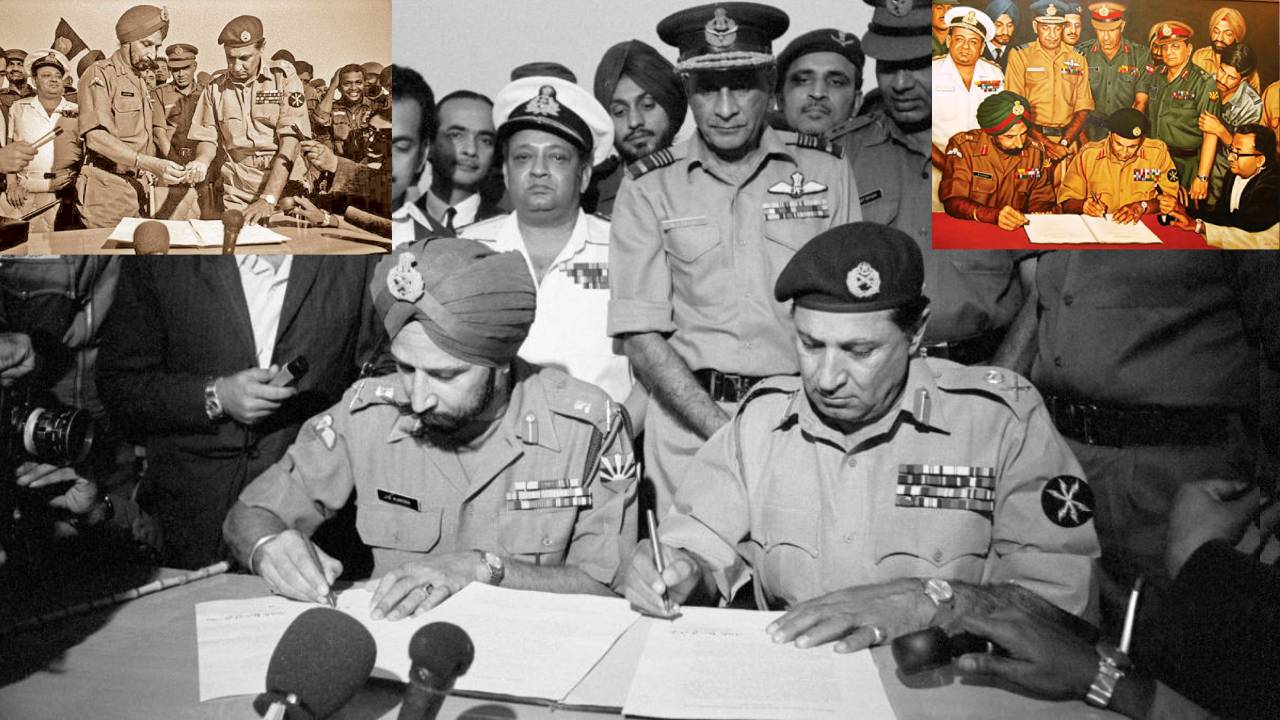
Bangladesh gained independence from Pakistan in 1971 through a long struggle and bloody war of liberation. But both India and Pakistan have been interpreting this historical event in their own way. In many Indian books, movies, and plays, 1971 is mainly presented as the “India-Pakistan War”, where the birth of Bangladesh is shown as the result of India’s military victory. As a result, a large section of the Indian public still considers Bangladesh’s independence a gift from India. Surprisingly, Pakistan also supports this narrative.
But the reality was different. The crisis began with the long movement of the Bengalis of East Pakistan to preserve their existence, the absolute victory of the Awami League in the 1970 elections, and the refusal of West Pakistan to transfer power. When the Pakistani army’s ‘Operation Searchlight’ began on the night of March 25, 1971, genocide, rape, and repression spread. Within a few months, about one crore people were forced to cross the border to save their lives and take refuge in India.
This refugee flow created a huge humanitarian, economic, and security pressure on India on the one hand. Initially, India tried to raise the issue diplomatically in the international arena and secretly provided training, weapons, and intelligence support to the Mukti Bahini. However, from March to November, India did not directly enter the war. The monsoon season, international politics, and the pro-Pakistan sentiment of the United States and China were major strategic considerations for India.
The situation changed in early December. When Pakistan attacked an Indian air base on December 3, India took it as a direct declaration of war. Then the allied forces, consisting of the Mukti Bahini and the Indian Army, began a full-scale military operation. By then, the Pakistani army had collapsed from within in the nine-month guerrilla war of the freedom fighters. Dhaka was quickly isolated by the Indian ground, air, and naval attacks.
Finally, Lieutenant General AA K Niazi, the head of the Pakistani Eastern Command, was forced to surrender to Indian General Jagjit Singh Aurora in Dhaka on December 16, 1971. About 93,000 Pakistani soldiers were taken prisoner, which went down in history as the largest military surrender since World War II.
Because of this visible reality, India continued to claim full credit for the war and established the Liberation War as an Indo-Pakistani war. Pakistan also found comfort in this, because surrendering to India was more “honorable” for them than defeat for the unarmed Bengalis.
However, one thing is clear in the analysis of historians—India’s support shortened the path of the war, but the main architects of Bangladesh’s independence were the freedom fighters and the general public. Even after 53 years of independence, it is the demand of the hour to highlight that sacrifice and truth anew.